
I was standing in front of an SS1 chemistry class in Kaduna when I first understood the rot in our educational system.
I was covering the absolute basics: acids, bases, and salts. I made reference to sodium chloride, the common salt we use at home. I looked up from the board, and every student was staring back at me with complete confusion. They did not know what salt was. I had to find a student who understood enough English to translate the word into Hausa. The moment he did, the entire class erupted:
"Oh, is this what you have been saying since?!"
That was 2016. I was serving in Kaduna as part of my mandatory NYSC program. I taught chemistry from SS1 to SS3. The classroom I was standing in was not a failing classroom on the margins of the education system. It was the system. And what I was watching was not a language barrier. It was the result of something far deeper: a generation of young people whose capacity to receive, process, and retain information had been quietly dismantled before they ever came to my class.
Those students did not fail to understand sodium chloride because they were unintelligent. They failed because nobody had trained their minds to sit, to focus, to work. They had transitioned from one class to another because there was a system enabling their failure: a system that failed to train their minds to learn; a system more focused on churning out students who went through, though the school never truly went through them.
I also observed that beyond the systemic educational failure were the fathers who were largely absent from that process. As they are absent from most of what is happening to this generation.
We Have No Idea What We Are Losing
There is a decision I made long ago about how I will raise my children: I will not expose them to screens.
I made that decision because I have seen what screens do to adults. Even if you consider yourself intentional and disciplined, you have likely noticed what constant exposure has done to you. You struggle to focus. You find it difficult to read for extended periods. Sitting still in prayer, in worship, in deep thought, without your mind immediately reaching for your phone, has become a daily battle.
Many intentional adults are waking up to this and fighting back. A friend of mine recently told me he turns off his mobile data completely each morning just so he can do his devotionals and read meaningfully. He is not trying to save data. He is trying to save himself. He is fighting to reclaim a mind that was once his.
But here is the danger that keeps me up at night: we adults know that our attention spans have been fractured because we remember what it used to be like. We have a baseline. Our children do not.
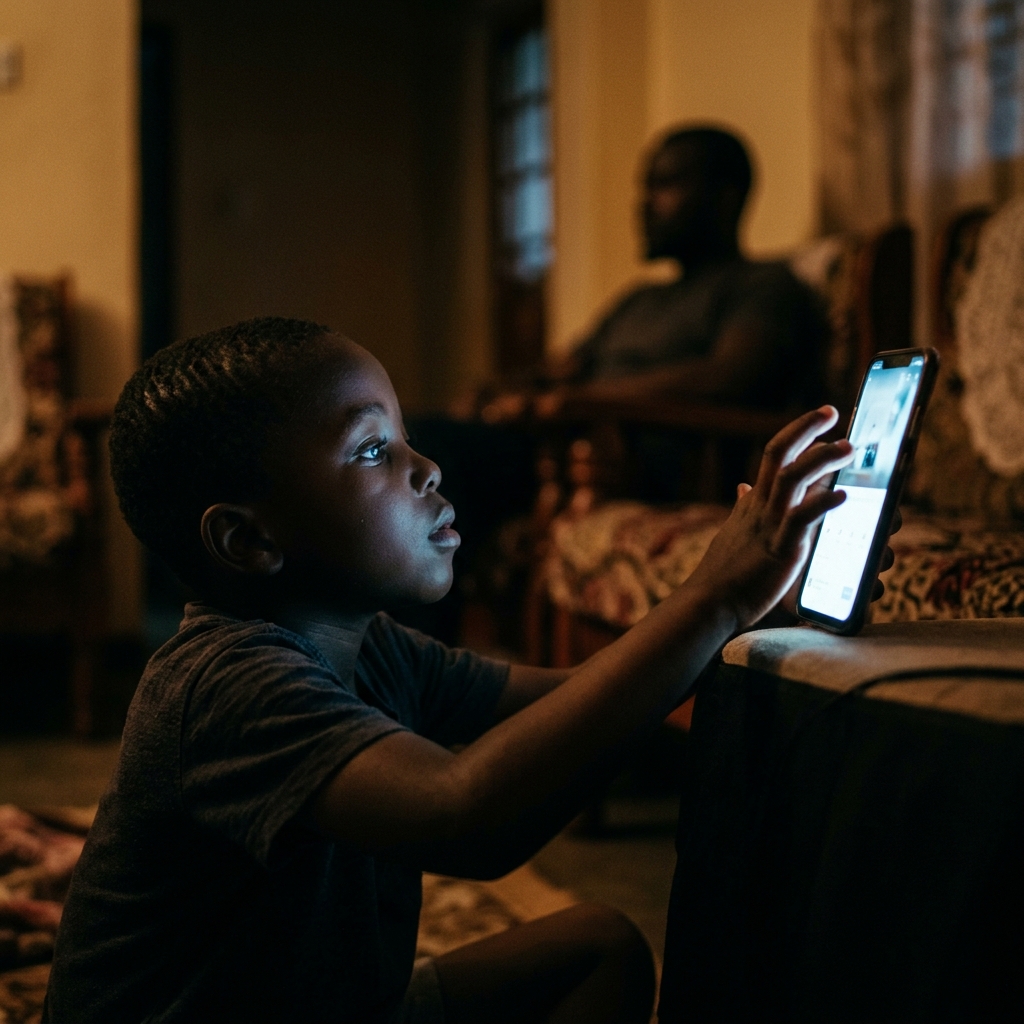
A child who has never experienced life without screens has no idea what the phone is stealing from them. They have never known what sustained focus feels like. They do not know what they are missing because they never had it in the first place. And this is where fathers must enter the conversation, because someone must be the one who remembers what is possible and refuses to let it disappear.
The Silent Crisis in Our Classrooms
Parents often complain that their children cannot pay attention, cannot focus on their studies, and cannot retain what they are taught. But what many of these same parents fail to realize is that they are actively contributing to the problem. By handing a child a phone or putting them in front of a screen just to keep them quiet, parents are buying themselves temporary peace and their children a permanent deficit.
I have been visiting schools recently and the academic performance I am seeing is deeply alarming. This is no longer an isolated problem. It is a national epidemic.
Nigeria is a multi-ethnic, multi-tribal country, and for years, federal universities maintained inclusion policies, lowering cut-off marks for students from Northern states to bridge genuine educational gaps. That was a specific, regional policy with a specific purpose. But today, lowering the standard is no longer a targeted measure. JAMB cut-off marks are being reduced across the board, some to 150, others to 120, simply to accommodate widespread, generational failure. The new generation is performing worse than the ones before it, across the country.
It looks like our paths are no longer shining brighter.
This is not what an education system does when it is functioning. A functioning system provides structures that elevate students to meet the standard. When we lower the bar instead, we are setting these young people up for a collision with reality they are entirely unprepared for. They will eventually leave the shores of this country and compete globally against people whose standards were never reduced. They will be unequipped and they will not understand why.
Technology is supposed to enhance human intelligence. Right now, it is doing the reverse.
The systemic rot I witnessed in Kaduna extended well beyond language and comprehension. During WAEC exams, teachers would write the answers on the board for students to copy. The corruption escalated from there: students paying to pass basic exams, and at the university level, resorting to bribes or desperate compromises with lecturers just to survive. These are not moral failures in isolation. They are what happens downstream when a child has never been taught to sit down, focus, work hard, and carry the weight of their own growth. When discipline is never installed, shortcuts become the only available strategy. And the father is the one who was supposed to install that discipline.
When I visited the Emir of that Kaduna village with my colleague Kolade, I mentioned the suggestion some teachers had made, that we should simply teach the students in Hausa rather than English. The Emir was direct:
"Never do that. The students should learn in English."
It was a decisive, counterintuitive act of leadership. He understood that accommodating the deficit was not the same as solving it. That was a memorable discussion. Someone had to hold the standard. Someone had to refuse to lower the bar. In the life of a child, that person is supposed to be the father. But unfortunately, the Emir wasn't actively involved enough to see his intention through. As fathers do. Good intentions are not enough.
The People Who Built the Pacifier Won't Give It to Their Own Children
The very people who created these technologies do not allow their children to use them.
Steve Jobs, the man who put the iPhone in the world, was once asked by a journalist how his children liked the iPad. He replied that his children had never used it. He imposed strict limits on their access to technology at home. He is not alone. Across Silicon Valley, among the engineers and executives building the platforms our children are consuming by the hour, screen time restrictions are standard practice. Many send their children to Waldorf schools: institutions that ban screens entirely and teach children through hands, craft, story, and deep attention.
The Jewish community, long known for producing disproportionate numbers of the world's leading thinkers, lawyers, doctors, and Nobel laureates, has for generations prioritized books, debate, memorization, and disciplined study over passive entertainment.
They train their children to think. We use their technology to put our children to sleep.
This is not a coincidence. The people closest to these tools understand their effects most clearly. And their response, when it comes to their own children, is to keep the tools away and build the mind first.
Fathers: This Is Our Assignment
The call to action in all of this belongs primarily to fathers.
In the Nigerian context and increasingly across the globe, the heavy lifting of raising children has been left to mothers. Our academic system is dominated by female teachers. At home, mothers are managing the children while fathers focus on their careers, their businesses, their phones, their football. The domestic and educational formation of the next generation has been outsourced entirely to women.
But mothers cannot give a child what only a father can give. There is a specific kind of discipline, structure, standard, and grit that children learn from watching a father operate. When that is absent, the child has no model for how to sit with difficulty, push through boredom, delay gratification, or carry the weight of their own future.
So this is what it looks like when fathers step in: You put the screen away and you give the child a book. You sit beside them while they study. You tell them to remain in that chair for two hours and you enforce it, not with harshness, but with consistency. You let them watch you read. You let them see you turn off your own phone when it is time to focus. You are the model. You are the blueprint. And if you are not providing it, there is nothing in the environment that will replace you.
If we do not intentionally step in, if we continue retreating to the parlour while our children drown in screens, we will raise a generation that cannot think, cannot build, and cannot lead.
The Decision Still Stands
I said at the beginning of this essay that I made a decision long ago: I will not expose my children to screens.
That decision is not made from ignorance of how the world works. It is made from knowledge of what these tools cost. I have stood in classrooms where that cost has already been paid, by children who will spend the rest of their lives trying to reclaim an attention span that was taken from them before they were old enough to protect it.
The father's assignment is to stand between the child and the pacifier. To hold the standard when everything in the culture is lowering it. To enforce the discomfort of focus and the discipline of sitting still, because on the other side of that discomfort is a mind that can actually build something.
As my wise friend Esther said:
"Attention is the currency of the future."
If we allow screens to bankrupt our children's minds today, there will be nothing left for them to build with tomorrow.
Fathers, take the screens away. And give them back their future.