
If you drive in Nigeria long enough, you'll notice something: it takes almost nothing for people to start raining abuses on you. A slight delay at a junction, a minor swerve, and suddenly tempers are flaring. Yesterday, however, I was reminded that most times, the anger is not really about what happened in that moment.
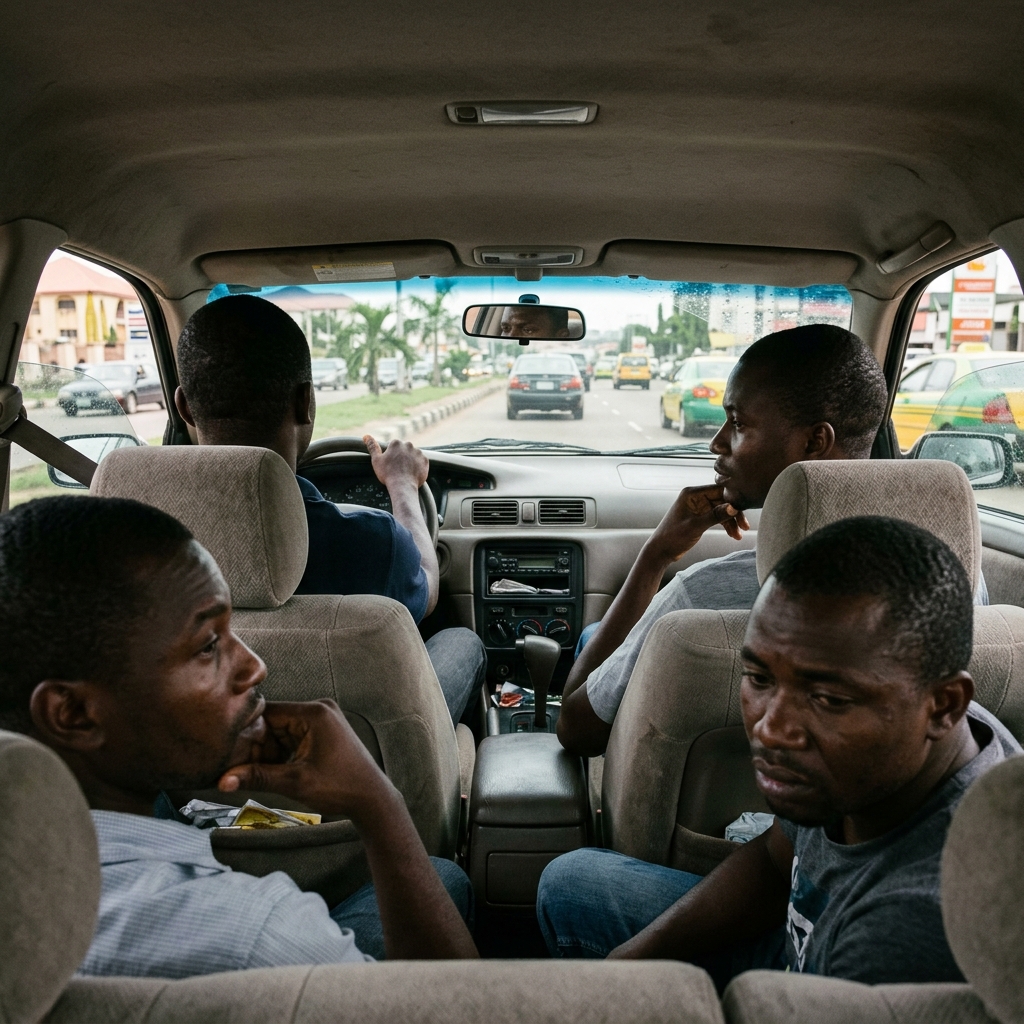
I was driving to the Federal Mortgage Bank in Abuja to reconcile my client's yearly repayment. Because our transport system isn't robust, carpooling and ride-sharing are common, so I picked up a few men along the way. Almost immediately, tension spiked. Two of the men got into a heated argument over seating arrangements. One was supposed to adjust for the other, and neither wanted to yield. Voices were raised, words were exchanged, and it nearly escalated before one of them finally agreed to move to the back seat.
To anyone watching, it would have looked like two grown men acting immaturely over a front seat.
But as the drive continued, the real issue surfaced.
The silence in the car broke when they started discussing the cost of transportation. One of them said he was queried for missing work for a day and #35,000 deducted from his salary. He was going to the office to meet with the management. He also mentioned that his monthly transport budget was ₦70,000 and the deduction was like half of his monthly fare. I smiled to myself because #70,000 is averagely my weekly fuel expenditure. Every man has his own battles.
A friend to the man who had been so angry earlier, the one who had fiercely argued over the seat, spoke up. His rent is due in November, and he admitted he had no idea how he was going to pay it. The man who had been ready to fight just minutes earlier was trying to figure out how to avoid becoming homeless.
Suddenly, everything made sense.
The car gradually turned into a confessional. Other men started sharing their own frustrations. They talked about how difficult the economy had become. Some mentioned that people they knew had stopped going to work because their salaries could no longer cover transportation costs. Another man confessed that one of his friends was considering quitting his job entirely.
I had to jump in and advise him. I told him, "You need at least six months of sustainable income before you make that move. Keep your job, build something on the side, and only leave when that side income can sustain you."
As I listened, one thing became obvious: many men are carrying far more pressure than the people around them realize.
When you see a man raging on the road, fighting over a minor scratch on his bumper, or arguing aggressively over something trivial, it is often not about that incident at all. It is transferred aggression. The trigger may be small, but the frustration behind it has usually been building long before that moment.
I see it all the time, even on construction sites, where an Oga transfers his aggression onto his boys. Sometimes I look at situations like that and wonder what burden the man is carrying that nobody else can see.
If I am being honest, it happens to me too.
There are times when I have a lot on my mind. If I don't talk about it or process it properly, the next person who makes a small mistake around me may receive a reaction that has little to do with them.
A man leaves his house carrying the burden of rent he cannot pay, a family he is struggling to provide for, and an economy that keeps moving the goalposts. He steps out already frustrated, and the slightest inconvenience becomes the spark.
Society tells men to "be a man," so they carry it quietly. They don't talk about the fear of losing their home. They don't talk about the anxiety of mounting bills or a transport budget that keeps rising. They bottle it up until it eventually comes out as anger.
But the most beautiful part of what happened yesterday was this: once these men started talking about what was really bothering them, the tension disappeared.
They realized they were fighting many of the same battles.
By the end of the trip, the same two men who had nearly fought over a seat had reconciled.
That reinforced something I have come to believe strongly: men need an outlet. They need a safe community where they can speak honestly and realize they are not alone. They need places where they can ask questions, learn from one another, and sometimes simply be heard.
Women are generally better at this. They talk, they share, and they release the pressure. Many men do the opposite. They carry everything themselves. And when they do not find healthy outlets through friendship, community, or conversation, that pressure often finds expression elsewhere, sometimes at work, sometimes on the road, and sometimes at home.
Personally, I belong to a healthy community called Men's Mandate, where we have these conversations. I also have my old school group where we joke, laugh, and ease the stress of everyday life. Sometimes, I leave my house just to sit with a friend and talk. The conversation does not magically solve my financial or emotional challenges, but I usually return home with a lighter heart.
And a lighter heart changes a lot.
This is why I will never stop being part of a community. Community helps a man stay grounded. A man trying to carry life's burdens entirely on his own will eventually struggle under the weight.
As we observe Men's Mental Health Month, my message is simple: find a safe space and talk.
And to society, when a man is brave enough to open up and show vulnerability, do not take advantage of it. Give him the listening ear he needs.
Sometimes, being heard is the first step toward healing.